
Published: March 1, 2026 · 10 min read · Category: Business Strategy
Most business owners considering an AI voice agent ask the wrong first question. They ask "How much does it cost?" when the right first question is "How much is it already costing me to not have one?"
The reality is that every business with a phone number is already paying an enormous hidden cost: the cost of missed calls, slow responses, after-hours voicemails that never get returned, and leads that called a competitor because no one picked up. This cost does not appear on any invoice or financial statement, which is exactly what makes it so dangerous. It is invisible revenue loss, and for most businesses, it dwarfs the price of an AI voice agent by an order of magnitude.
This article gives you a concrete, step-by-step framework to calculate the actual return on investment of deploying an AI voice agent for your specific business. No hand-waving, no vague promises. Just math.
Step 1: Calculate Your Invisible Cost of Missed Calls
Before you can calculate the ROI of a solution, you need to quantify the problem. Here is how to estimate what missed calls are currently costing your business.
Gather three numbers from your business:
Number A — Total Monthly Inbound Calls: Check your phone system analytics, call logs, or ask your provider. This includes answered calls, missed calls, and voicemails. If you do not have exact data, a reasonable estimate for a small to mid-sized business is 200 to 500 inbound calls per month. For businesses running paid advertising, this can be significantly higher.
Number B — Your Current Answer Rate: What percentage of those inbound calls actually get answered by a human? Be honest. Include after-hours calls, lunch breaks, times when all lines are busy, and calls that go to voicemail. Most businesses overestimate their answer rate. Industry data consistently shows that the average small business answers only 38 percent of its inbound calls. Even businesses that think they answer most calls are typically missing 30 to 40 percent.
Number C — Your Average Revenue Per Converted Call: When an inbound call does convert into a customer, what is the average revenue from that transaction? For a dental practice, a new patient might be worth $500 for the first visit and $3,000 over their lifetime. For a home services company, an average job might be $350. For a real estate team, a converted buyer might represent $8,000 in commission. Use a conservative estimate — the first transaction value, not the lifetime value.
Now calculate:
Missed calls per month equals Total Monthly Calls multiplied by the quantity one minus your Answer Rate. If you receive 400 calls per month and answer 40 percent of them, you are missing 240 calls every month.
Not every missed call would have converted, even if answered. Apply a conservative conversion rate. For most businesses, 15 to 25 percent of answered inbound calls convert into a paying customer. Using 20 percent as a middle estimate is reasonable.
Potential conversions lost per month equals Missed Calls multiplied by 0.20. From 240 missed calls, that is 48 potential customers lost.
Monthly revenue lost to missed calls equals Potential Conversions Lost multiplied by Average Revenue Per Converted Call. At 48 lost conversions and $350 average revenue per job, that is $16,800 per month in lost revenue. At $500 per new patient, it is $24,000. At $8,000 per real estate commission, the number becomes staggering.
Even using the most conservative estimates, most businesses discover they are losing five figures per month to unanswered calls. This number typically shocks business owners because they never see it on a report. It is simply revenue that never existed because the phone was never answered.
Step 2: Calculate Your Current Cost of Handling Calls
Now consider what you are currently spending to handle the calls you do answer.
If you have a dedicated receptionist or phone team:
Calculate the fully loaded cost of every person whose primary or significant secondary role is answering phones. Include their annual salary or hourly wage multiplied by hours worked per month, employer payroll taxes which are typically 7.65 percent of salary, health insurance and benefits, training costs averaged per month, management and supervision time, recruiting and replacement costs averaged per month since the average receptionist tenure is 12 to 18 months, and any phone system or software costs.
For a single full-time receptionist in the United States, the fully loaded cost typically ranges from $3,200 to $5,500 per month.
If the business owner or team members answer calls themselves:
This cost is harder to quantify but is very real. Every minute a business owner spends answering a routine phone inquiry is a minute not spent on billable work, sales meetings, strategic planning, or operations management. If a business owner's time is worth $100 to $300 per hour and they spend 2 hours per day handling phone calls, that is $200 to $600 per day in opportunity cost, which is $4,000 to $12,000 per month.
If you use an answering service or call center:
These typically charge $0.75 to $1.50 per minute of call time, with additional fees for after-hours coverage, appointment scheduling, and message relay. A business handling 300 calls per month at an average of 3 minutes per call pays $675 to $1,350 per month — and the quality of these services is notoriously inconsistent because the operators handle calls for dozens of different businesses simultaneously.
Step 3: Estimate the Revenue an AI Voice Agent Would Recover
An AI voice agent does not answer 38 percent of your calls. It answers 100 percent of them. Every call, every time, 24 hours a day.
Conservative Recovery Estimate:
Not all of the 240 missed calls in our example would have been reached even with an AI agent. Some callers may hang up before the AI finishes its first sentence. Some may be spam or wrong numbers. Apply a conservative reachability factor of 80 percent.
Calls now answered that were previously missed equals 240 multiplied by 0.80, which is 192 additional answered calls per month.
Apply the same 20 percent conversion rate. That is 38 additional conversions per month.
At $350 per conversion, that is $13,440 per month in recovered revenue.
At $500 per conversion, that is $19,200 per month.
At $8,000 per conversion, it is $307,200 per month.
Additional Revenue From After-Hours Capture:
Most businesses receive 25 to 35 percent of their total call volume outside of business hours — evenings, weekends, and holidays. These calls almost universally go to voicemail. An AI voice agent captures them. If your after-hours calls represent 30 percent of total volume and you were previously answering zero percent of them, the AI adds an entirely new revenue stream that did not exist before.
Revenue From Faster Speed-to-Lead:
For businesses that receive inbound inquiries from advertising or lead platforms, the speed of response directly affects conversion rate. Research from Lead Connect shows that responding to a web lead within 5 minutes makes you 100 times more likely to connect and 21 times more likely to qualify the lead compared to responding after 30 minutes. An AI voice agent that calls leads back within seconds of form submission dramatically increases the conversion rate on marketing spend you are already paying for.
Step 4: The ROI Formula
Now bring it all together.
Monthly ROI equals the sum of Recovered Revenue plus Current Handling Cost Savings minus the Monthly AI Agent Cost.
Let us run the numbers for a mid-sized home services company.
The current situation shows 400 inbound calls per month with a 40 percent answer rate, meaning 240 missed calls per month. They have one full-time dispatcher/receptionist costing $4,200 per month fully loaded. Their average job value is $400.
On the cost side, the AI voice agent costs $99 per month as an example mid-tier plan. Adding tools and integrations brings it to $49 per month. The total monthly AI cost is $148.
On the value side, previously missed calls now answered total 192 per month. At a 20 percent conversion rate, that yields 38 additional jobs. At $400 per job, that equals $15,360 in recovered revenue.
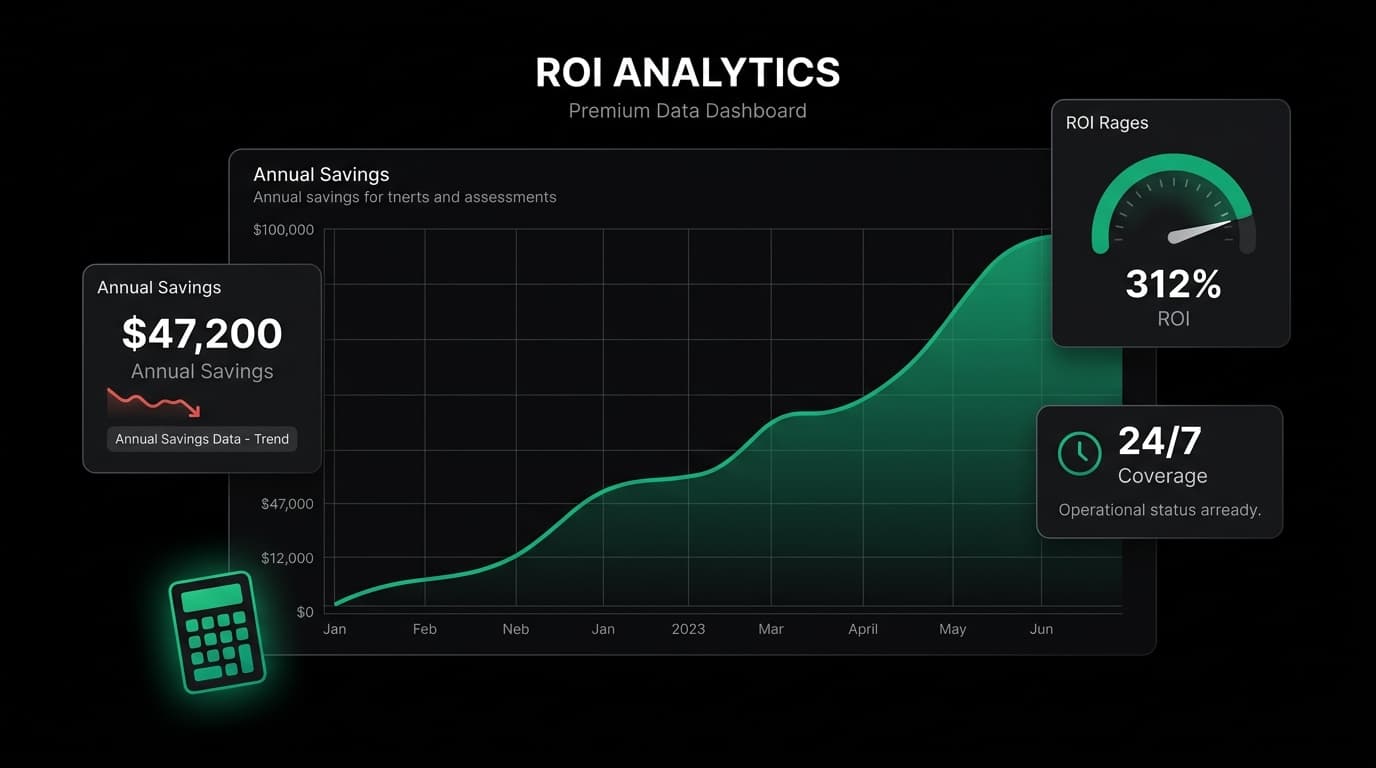
They can now reduce the receptionist role to part-time (the AI handles most calls, the human handles complex situations and in-person customers), saving $2,100 per month. Adding the recovered revenue of $15,360 to the cost savings of $2,100 gives a total monthly value of $17,460. Subtracting the AI cost of $148 leaves a net monthly ROI of $17,312.
That is an annualized return of $207,744 on a $1,776 annual investment. That is a return of over 11,000 percent.
Even if you cut these numbers in half to be ultra-conservative — assume only 10 percent of recovered calls convert, or assume a lower average job value — the ROI is still measured in thousands of percent. The math is not close. It is overwhelming.
Step 5: Account for the Intangible Benefits
The financial ROI above only captures the directly measurable revenue and cost impacts. There are significant additional benefits that are harder to quantify but very real in practice.
Consistency of experience. An AI voice agent never has a bad day. It never sounds annoyed, rushed, or distracted. Every caller receives the same warm, professional, thorough experience. This consistency builds brand reputation over time in ways that are difficult to measure but powerfully impactful.
Data quality. When a human receptionist takes a message, the data quality is inconsistent. Names are misspelled, phone numbers have wrong digits, notes are vague. An AI voice agent captures data with perfect accuracy every time and pushes it to your CRM in a structured format. This eliminates the downstream cost of bad data — callbacks to wrong numbers, lost context, duplicate records.
Employee satisfaction. If your team currently handles phone calls as a secondary responsibility alongside their primary job, removing that burden dramatically improves their focus, productivity, and job satisfaction. An HVAC technician who no longer has to stop in the middle of an installation to answer their phone is safer, more efficient, and happier.
Scalability. Hiring a new receptionist takes 2 to 4 weeks of recruiting, interviewing, and training. Deploying an AI voice agent takes minutes. When your business grows or you run a marketing campaign that spikes call volume, the AI scales instantly. You never need to worry about being understaffed for the phones again.
Competitive advantage. In most local markets, the business that answers the phone first wins. If you are the only plumbing company in your area with an AI agent that answers every call within two rings at 10 PM on a Saturday, you will capture jobs that every one of your competitors is missing.
Common Objections (And Why They Do Not Hold Up)
"My customers want to talk to a real person."
Your customers want their problem solved. They want to be heard, understood, and helped — quickly. A modern AI voice agent delivers all three of those things. The callers who insist on a human can be seamlessly transferred. But the vast majority of callers — the ones who just need to book an appointment, get a question answered, or provide their information — are perfectly happy interacting with an AI that is responsive, knowledgeable, and efficient. They are certainly happier than being sent to voicemail.
"AI is too expensive for my small business."
An AI voice agent costs less than what most businesses spend on their monthly phone bill. If your phone system costs $50 to $100 per month and you are missing 60 percent of the calls that come through it, you are paying for infrastructure that is failing to serve its purpose. An AI voice agent that costs $49 to $149 per month and answers 100 percent of those calls is not an expense — it is a correction to a broken system.
"What if the AI makes a mistake?"
Humans make mistakes on the phone constantly. They mishear names, forget to ask qualifying questions, lose notes, fail to follow up, and occasionally have rude or off-putting interactions with callers. The question is not whether AI is perfect. The question is whether AI is better than voicemail — and that answer is unequivocally yes.
The Decision Framework
If your business relies on phone calls for revenue — and most businesses do — the decision to deploy an AI voice agent comes down to a simple comparison.
On one side, you have the cost of the AI agent: a predictable monthly fee, typically between $49 and $299 depending on capabilities and scale. On the other side, you have the cost of NOT having one: thousands of dollars per month in missed calls, lost leads, slow response times, after-hours dead zones, and overwhelmed staff.
The gap between these two numbers is your ROI. For virtually every business we have analyzed, that gap is enormous. The AI agent does not need to be 10 times better than a human receptionist to deliver extraordinary returns. It just needs to answer the calls that nobody else is answering. And there are a lot of those calls.
Your Next Step
Stop guessing and start measuring. Pull your phone system data for the last 90 days. Count your total inbound calls. Count how many were missed or went to voicemail. Multiply by your average customer value. That number — the revenue you are currently leaving on the table — is the starting point for your ROI calculation.
Then ask yourself: if there were a system that could recover even a fraction of that lost revenue for less than the cost of a single employee's daily wage, would you deploy it?
The math answers that question for you.
Ready to stop losing revenue to missed calls? See Our Plans & Pricing →