
Published: March 1, 2026 · 9 min read · Category: Industry Trends
Every missed phone call is a missed opportunity. For most businesses, that is not a cliché — it is a financial reality backed by hard data. Research from BIA/Kelsey has shown that inbound phone calls convert to revenue 10 to 15 times more often than web leads. Yet the average small business misses 62 percent of the phone calls it receives, according to a 2024 study by Numa. That gap between the calls that come in and the calls that actually get answered represents one of the biggest silent revenue leaks in modern business.
For decades, the only solution was hiring more people. More receptionists, more sales development reps, more after-hours call center staff. But headcount is expensive, inconsistent, and impossible to scale overnight. A single inside sales agent in the United States costs between $45,000 and $65,000 per year in salary alone before you add benefits, training, management overhead, and the inevitable turnover.
In 2026, a new category of technology is closing that gap permanently: AI voice agents.
What Exactly Is an AI Voice Agent?
An AI voice agent is not a chatbot. It is not an IVR phone tree that asks you to "press 1 for sales." It is not a robocall reading a script in a monotone synthetic voice.
A modern AI voice agent is a real-time conversational AI system that can answer a phone call, understand what the caller wants, respond in natural human-sounding speech, make decisions during the conversation, take actions like booking appointments or looking up information, and do all of this indistinguishably from a well-trained human employee.
The technology stack that makes this possible has matured dramatically over the past 18 months. Large language models provide the reasoning and conversational intelligence. Real-time speech-to-text engines convert the caller's words into text with sub-200-millisecond latency. Text-to-speech engines generate natural, expressive voice output that sounds warm, professional, and human. Telephony infrastructure connects all of this to the actual phone network so the AI can answer calls on a real phone number.
When a customer calls a business using an AI voice agent, they hear a friendly greeting, have a natural conversation, get their questions answered, and often have an appointment booked on their calendar — all before they realize they were not speaking with a human. The experience feels no different from calling a company with a great receptionist or a sharp sales development rep.
Why 2026 Is the Tipping Point
AI voice technology has existed in various forms for years, but several converging factors have made 2026 the year it crosses from novelty into mainstream business adoption.
The first factor is latency. Early voice AI systems had noticeable delays between when the caller stopped speaking and when the AI responded. Those pauses made conversations feel robotic and frustrating. Modern systems have pushed that latency below the threshold of human perception. The AI responds as quickly as a human would, creating conversations that feel natural and fluid.
The second factor is voice quality. The synthetic voices available today are remarkably expressive. They laugh at the right moments. They emphasize key words naturally. They adjust their tone based on the context of the conversation. The uncanny valley that plagued earlier text-to-speech systems has been crossed. Callers genuinely cannot tell the difference.
The third factor is intelligence. With the reasoning capabilities of modern large language models, AI voice agents can handle complex conversations that go off-script. If a caller asks an unexpected question, the AI does not freeze or repeat a canned response. It reasons through the question, pulls from its knowledge base, and provides a thoughtful answer. It can handle objections, navigate difficult personalities, and guide conversations toward a desired outcome like booking an appointment or qualifying a lead.
The fourth factor is accessibility. Building an AI voice agent used to require a team of machine learning engineers, months of development time, and hundreds of thousands of dollars. Today, platforms have emerged that let a business owner deploy a fully functional AI voice agent in minutes, with no technical expertise required. The barrier to entry has collapsed.
The Old Way vs. The New Way
To understand the impact, consider how a typical business handles inbound calls today.
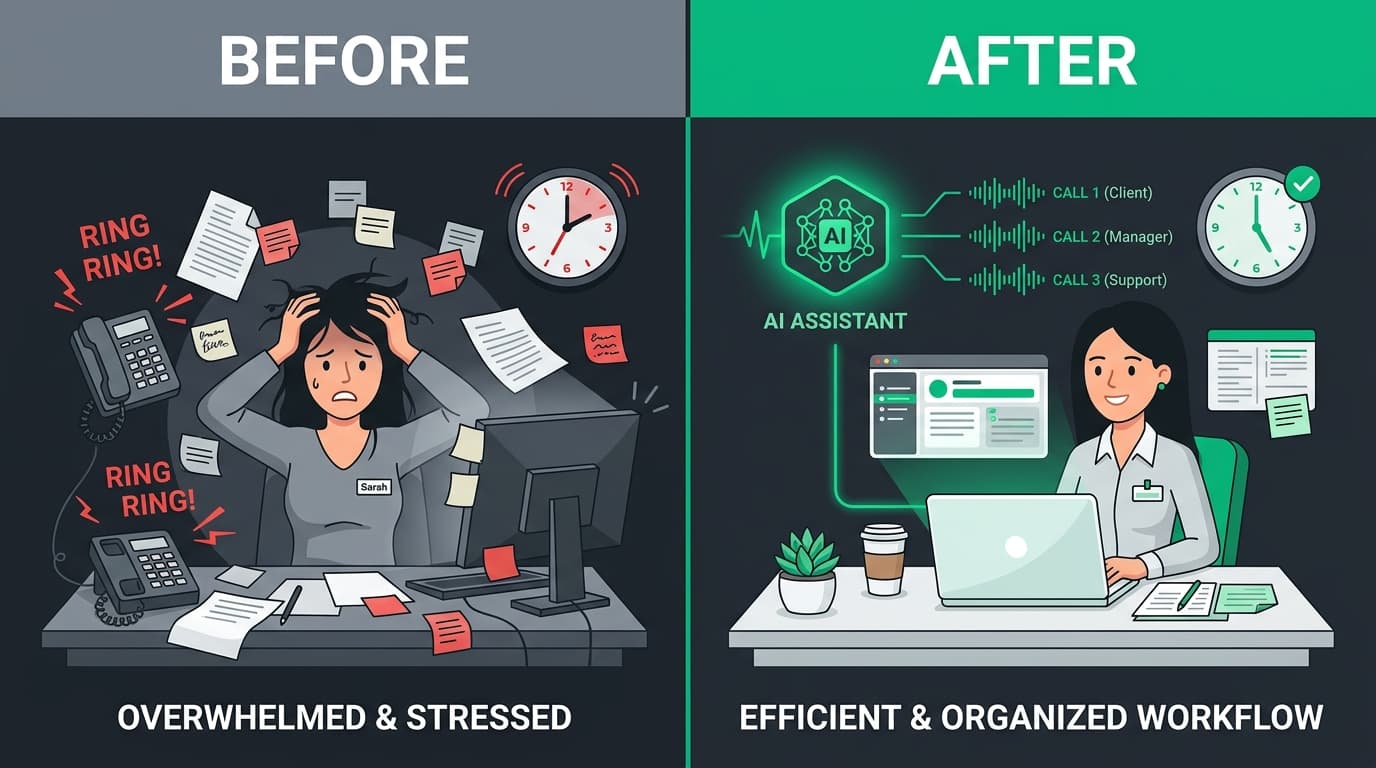
In the traditional model, a call comes in during business hours. If someone is available, they answer. If not — because they are on another call, in a meeting, at lunch, or simply understaffed — the call goes to voicemail. The caller, who is likely also considering competitors, may or may not leave a message. If they do, someone has to listen to the voicemail, manually log the information, call them back, and hope they answer. After business hours, the phone rings with no one to answer at all. Weekends and holidays are complete dead zones.
In the AI voice agent model, every single call is answered instantly, every hour of every day. The AI greets the caller warmly, asks qualifying questions, answers their inquiries using a comprehensive knowledge base, and takes the appropriate action. For a real estate company, that action might be booking a property showing on the agent's calendar. For a dental practice, it might be scheduling a cleaning appointment. For a SaaS company, it might be qualifying the lead and routing hot prospects to a human sales rep with a full context summary.
The call data — transcript, caller information, appointment details, qualification notes — is automatically logged in the business's CRM. No manual data entry. No sticky notes. No leads falling through cracks.
How Modern AI Voice Agents Actually Work
The technical architecture of a modern AI voice agent operates in a continuous real-time loop during a phone call.
When a call arrives on the business's phone number, the telephony system routes it to the voice AI platform. Within milliseconds, the AI agent activates and plays its greeting. As the caller speaks, their audio is streamed to a speech-to-text engine that transcribes their words in real time. That transcription is fed to a large language model along with the agent's instructions, personality guidelines, and business knowledge base. The model generates an appropriate response. That response text is sent to a text-to-speech engine that produces natural-sounding audio. The audio is streamed back through the phone line to the caller. This entire loop — listen, understand, think, speak — happens continuously throughout the conversation with imperceptible latency.
What makes this especially powerful for businesses is the action layer. During the conversation, the AI agent can perform real actions: checking a calendar for available time slots and booking an appointment, creating or updating a record in the company's CRM system, sending a text message to the caller with a link or confirmation, transferring the call to a human team member with a full context summary if the situation requires it, and triggering custom webhooks that connect to virtually any business system.
After the call ends, a post-processing pipeline analyzes the full conversation, extracts structured data (caller name, email, budget, timeline, specific needs), generates an intelligent summary, scores the lead, and pushes everything to the appropriate business systems automatically.
What This Means for Different Types of Businesses
The applications span virtually every industry where phone calls matter, which is to say, nearly every industry.
Service-based businesses like HVAC companies, plumbers, electricians, and cleaning services miss calls constantly because their teams are in the field. An AI voice agent ensures every service inquiry is answered and every appointment is booked, even when the entire team is on job sites.
Professional practices including dental offices, law firms, medical clinics, and accounting firms spend significant money on front-desk staff whose primary job is answering phones and scheduling appointments. An AI voice agent handles this work around the clock at a fraction of the cost.
Real estate brokerages deal with a flood of inbound inquiries from listing platforms. Speed to response is the single biggest factor in converting these leads. An AI voice agent answers every inquiry instantly, qualifies the lead, and books a showing before the prospect calls a competing agent.
Insurance agencies, solar installation companies, home service franchises, and automotive dealerships all share the same fundamental challenge: high-value phone leads that need immediate, intelligent response. AI voice agents are purpose-built to solve this problem.
The Economics Are Compelling
The financial case for AI voice agents is straightforward when you compare the numbers.
A full-time inside sales agent or receptionist costs a business between $3,500 and $6,000 per month when you account for salary, benefits, taxes, and overhead. That employee works roughly 8 hours per day, 5 days per week, and requires training, management, vacation coverage, and eventually replacement when they leave. Even the best human employee can only handle one call at a time.
An AI voice agent typically costs between $49 and $299 per month depending on the platform and capabilities. It works 24 hours a day, 7 days a week, 365 days a year. It never calls in sick, never has a bad day, never forgets to log a lead in the CRM, and can handle multiple concurrent calls simultaneously. It requires no training — the training was done by the platform's engineering team. It improves over time as the underlying AI models are updated.
For most businesses, the question is not whether they can afford an AI voice agent. The question is whether they can afford to keep missing 62 percent of their incoming calls.
What to Look for in an AI Voice Agent Platform
Not all AI voice agent platforms are created equal. If you are evaluating options for your business, there are several critical factors to consider.
The first is voice quality and naturalness. Listen to sample calls. Does the AI sound like a real person? Can it handle interruptions, overlapping speech, and natural conversation flow? Or does it sound robotic and scripted?
The second is industry-specific intelligence. A generic AI that can have a conversation is very different from an AI that has been trained on your industry's specific objection-handling frameworks, qualification methodologies, and domain knowledge. The best platforms offer pre-trained "expert" agents for specific industries that work out of the box with minimal setup.
The third is integration depth. An AI voice agent that cannot book appointments on your actual calendar, push leads to your actual CRM, or trigger actions in your actual business tools is just a fancy answering machine. Look for platforms with deep native integrations and webhook support.
The fourth is the setup experience. You should not need a development team to deploy an AI voice agent. The best platforms let you go from signup to live agent in minutes, with guided setup wizards that personalize the agent for your specific business context.
The fifth is transparency and control. You should be able to see every call transcript, listen to every recording, review every action the AI took, and adjust the agent's behavior without needing technical skills.
The Shift Is Already Happening
The businesses adopting AI voice agents today are not the ones with the biggest budgets or the most sophisticated technology teams. They are the ones that recognized a simple truth: in a world where every lead has infinite options and zero patience, the business that answers the phone first wins.
AI voice agents are not replacing human connection. They are ensuring that human connection actually happens — that the call gets answered, the lead gets qualified, the appointment gets booked, and the opportunity does not slip away into a voicemail box that nobody checks until Monday morning.
The question for your business is not whether AI voice agents will become standard. That is already decided. The question is whether you will be the first in your market to deploy one, or the last.
Ready to see what an AI voice agent can do for your business? Explore our Expert AI Agents →